
Code compliance review is the last thing that happens to a construction document set, and it usually happens under a deadline with a team that has been drawing all day. Design errors already account for 1 to 9 percent of total project cost, and the violations that get cited most often in the field are the ordinary ones: fire-stopping, egress, ADA clearances, handrails, fire-protection systems.
Software can now do a first pass on that work. Five commercial plan-check platforms are in market in 2026, checking drawings against the International Building Code, NFPA, ADA, FHA, and local amendments. What comes back is a list of flags for a person to work through, and the liability for every one of those calls sits where it always did.
This article covers what AI plan check catches reliably, what it can't, where your professional liability sits when you use one, and what your firm needs in place before any of it is useful.
The 2 AM Plan Check
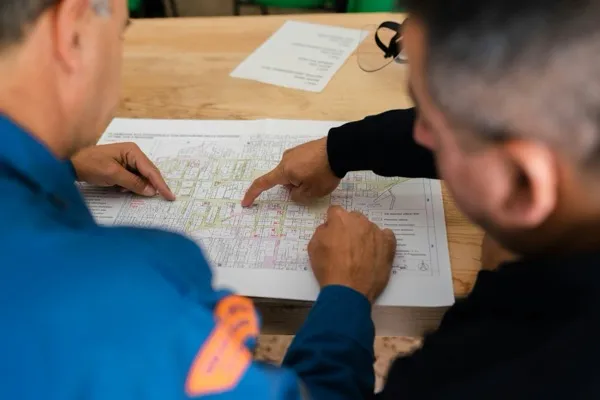
At 2 AM, four hours before the 6 AM permit submission deadline, the QA/QC lead at a mid-size architecture firm ran an AI plan check on the final construction documents. It flagged one issue: a fire-rated corridor assembly where a detail change from three revisions back had never propagated to the wall section. It was real.
Scenario composited from typical mid-market architecture firm workflow— not a specific named client.
The lead walked the flag down to the project architect, who pulled the wall section, confirmed the break, and stopped the submission. The team issued a corrected set at 8 AM instead of shipping a package with a fatal defect. No rejection. No resubmittal fee. No non-compliant corridor built out six months later.
AI-assisted compliance checking doesn't replace the architect's professional judgment. It gives the architect a punch list to adjudicate— fast enough to matter at 2 AM.
This scene is happening in architecture firms across the country in 2026.
Why the 2 AM Scene Is Possible in 2026
Commercial AI plan-check platforms for architecture firms are now a 2026 operational category— not a 2030 speculation. Five platforms (CodeComply, Ichi, InspectMind, PlanCheckPro, and CivCheck) are actively in market, checking drawings against the International Building Code, NFPA, ADA, FHA, and local amendments.12345
Each parses construction documents and BIM data, compares against codified rules, and returns a flag list for the architect to adjudicate. The ICC publishes the International Building Code these platforms check against, and local Authorities Having Jurisdiction adopt the IBC with amendments— the better tools handle those too.
| Platform | Code Coverage | Positioning |
|---|---|---|
| CodeComply1 | ICC, NFPA, ADA, FHA + local amendments | Cleaner plan submittals, fewer resubmittals |
| Ichi2 | Building codes across architecture + engineering | QA/QC and submittal automation for A/E firms |
| InspectMind3 | Code, spec, and coordination | Pre-permit plan check in hours, not weeks |
| PlanCheckPro4 | Building codes with ML matching | Flagged issues with direct code citations |
| CivCheck5 | Permit-ready code checks | Dual-use: applicants and city reviewers |
BuiltWorlds' 2026 roundup documents 40 AI-driven AEC platforms in market,6 confirming AI has moved from pilot to commercial category. Allplan's 2026 trend analysis describes the underlying shift: the industry is moving from document-driven processes to continuous data-driven workflows where AI is part of regular practice.7
Knowing the platforms exist is one thing. Knowing what they catch— and what they miss— is another.
What AI Catches Well (and What It Doesn't)
AI plan-check tools are strong on codified, measurable items— egress widths, stair geometry, guardrail heights, fire-rating continuity, ADA clearances, zoning setbacks— and weak on interpretive judgment calls like equivalent compliance and code intent.
These tools do rule-matching. If code requires a fire-rated corridor to maintain continuity, the AI checks whether every wall section carries the rating. Deciding whether an equivalent method of compliance is acceptable for a specific condition is still the architect's call.
| AI Catches Well | Architect Must Still Adjudicate |
|---|---|
| Egress widths and exit counts | Equivalent compliance determinations |
| Stair geometry (tread, riser, landing) | Code intent in ambiguous conditions |
| Guardrail and handrail heights | Jurisdictional interpretation (AHJ discretion) |
| Fire-rating continuity across assemblies | Life-safety design decisions beyond literal code |
| ADA clearances and accessibility routes | Design-for-intent on complex programs |
| Zoning setbacks and lot coverage | Professional-judgment calls on edge cases |
The categories AI catches well line up with the most common building code violation categories in the field: fire-stopping, egress, ADA, handrails, and fire-protection systems.89 Vendors built their rule libraries against the violations that get cited.
And here's the boundary. Equivalent compliance, code intent, and jurisdictional interpretation are still the architect's call— AI can surface the question but can't answer it. AIA Trust guidance treats AI as a complementary assist, not a replacement for human effort.10 Proving Ground's analysis names five ethical pressure points where AI meets the architect's code of conduct, with professional judgment at the top.11
The AI generates the punch list. The architect adjudicates each item. The firm ships a cleaner set.
Knowing what AI catches is half the picture. What happens to professional liability when a firm relies on it?
Liability Doesn't Move
Using AI-assisted plan check does not change the architect's professional liability. The licensed architect remains legally responsible for code compliance under theories of breach of contract, negligence, and professional malpractice— whether or not AI was part of the review.12
AI doesn't shift any of those three theories. Contract language can impose compliance obligations exceeding the generally accepted standard of care— which is why the contract your firm signs matters more than the tooling it uses.12 Negligence remains a primary driver of liability exposure, with or without AI in the workflow.14
The stakes are not abstract. Berkley Design Professional documents a $900,000 settlement from a single emergency escape and rescue window code failure after a building-type change— the kind of issue AI plan-check is designed to catch.13 E&O coverage remains the financial backstop regardless of AI use.
There's an upside for firms that document their process. Each AI run leaves a record of what was checked, what was flagged, and what the architect decided— the artifact for insurance review and any licensing-board proceeding. Firms weighing their broader AI governance strategy should put the audit-trail practice near the top of the list.
What a good AI-assisted QA/QC audit trail should capture:
- Tool run timestamp and file identifier
- Ruleset version (code cycle + local amendments loaded)
- Flagged items with code citations
- Architect's disposition of each flag (confirm / dismiss / override with rationale)
- Final sign-off by the architect of record
Used well, AI doesn't increase liability exposure— it creates a cleaner paper trail.
The AIA has spoken to exactly this question.
What the AIA Says in 2026
The American Institute of Architects published an AI Position Statement and Responsible Use Guidance in January 2026, positioning AI as an assist to— not a replacement for— professional judgment.15 The AIA AI Task Force is building on that guidance with forthcoming firm-readiness resources for firms to assess their own AI maturity.
The guidance is clear: AI supports professional judgment. It does not replace it. The AIA issues professional conduct standards that govern architects' use of AI, layered on the 2024 Code of Ethics and Professional Conduct.16 Two focus areas anchor the guidance: professional responsibility and data governance.
AI should not be seen as a replacement for human effort but as a complementary assist.— AIA Trust10
AIA Trust echoes the same stance on QA/QC integration.17 Firms are folding AI output into the peer-review flow rather than replacing it.
Even with the guidance clear, operational reality is messier. Not every firm is ready to run AI plan-check tomorrow.
The Firm-Side Prerequisites
Running AI plan-check effectively requires three prerequisites: clean BIM parameter standards, a QA/QC protocol that integrates AI output with human peer review, and an audit-trail practice for every run. Without them, AI plan-check generates noise instead of signal.
- BIM data hygiene. Clean parameters, consistent metadata, reliable pipelines. If BIM parameters are inconsistent, the AI will flag the wrong things— or miss the right ones. The shift from document-driven to data-driven workflows assumes the data is trustworthy.7 Budget as much time for data cleanup as for the license. This is one of the hidden costs of AI projects vendor pages skip.
- QA/QC integration. Peer review is still the backbone. AI augments it; it doesn't replace it.1719 AI output flows INTO peer review— the reviewer works the flag list with the designer and adjudicates. Teams that already practice peer review adapt quickly. Teams that don't, struggle.
- Audit-trail practice. Each run produces a record— the artifact for insurance and licensing. Without it, the AI run is invisible six months later when a question surfaces. Firms looking at measuring AI success in QA/QC should start here.
Firms without these foundations will find AI plan-check frustrating rather than useful. Design-related errors already account for 1–9% of total project cost,18 so noisy AI output has a real downstream penalty. Start with the data hygiene.
Which brings us to the harder truth the 2 AM story is telling.
The Deeper Point: The Goal Is Not More 2 AM Saves
The 2 AM save is a story about a firm that got lucky. The real goal is to push AI-assisted compliance earlier— schematic design, design development, before the pressure cooker of submission week.
Design errors account for 1–9% of total project cost,18 and rework clusters between 4–10% of project value.20 Aerospace research on design decisions found late-stage changes cost materially more to fix than early-stage ones— the principle transfers to AEC even if the exact multiplier doesn't.21
Catching a fatal code issue four hours before submission is better than catching it after submission. Catching it in SD is better than either.
Push AI into SD and DD review, where catches turn into quiet corrections rather than emergency stops. A firm that runs AI plan-check at every milestone— SD, DD, 50% CD, 95% CD— spreads catches across the timeline so no single run has to find them all.
A 2 AM save makes for a good story. A schematic-design catch makes for a better project. Building an AI-ready culture is treating AI plan-check as a scheduled review, not a panic button.
Which leads to the core question for any architecture firm in 2026: what's the right way to adopt this?
What This Means for Your Architecture Firm
Firms getting this right treat AI-assisted compliance checking as augmentation of QA/QC, not a replacement for peer review. The architect remains the one signing the drawings. The goal isn't more 2 AM saves— it's fewer 2 AM crises, because AI has been doing quiet work upstream all along.
Practical starting points: pilot AI plan-check in SD on one project type. Build the audit-trail practice before scaling. Measure time-to-flag-resolution, not flags-generated. A TestFit case study reports BSB Design cut density-study time by up to 75%, reducing feasibility studies from two weeks to about two days.22 Jurisdictions using AI plan-check tools report 30–40% faster plan review cycles.23
AI doesn't make the architect less necessary. It makes the architect more effective. The parts AI can take are the parts to let go— pure code-matching work that was never the professional contribution.
If your firm is weighing how to integrate AI into QA/QC without losing the professional judgment that keeps you out of the claim file, that's the work Dan Cumberland Labs does with founder-led AEC firms. Our AI implementation services can map whether this is ready for your workflow— or whether BIM hygiene is the first thing to fix.
The architect is still the one signing the drawings. AI just made the 2 AM save possible.
Frequently Asked Questions
Answers to the most common questions architecture firms ask about AI-assisted compliance checking.
Can AI replace an architect's code compliance review?
No. The AIA's January 2026 Responsible Use Guidance positions AI as an assist to— not a replacement for— professional judgment.15 The licensed architect remains responsible for every compliance determination. AI generates the punch list; the architect adjudicates each flag.
What does an AI plan check look at?
AI plan-check tools parse construction drawings and BIM data and compare them against codified rules— the International Building Code, NFPA, ADA, FHA, and applicable local amendments.1 They flag items like egress widths, stair geometry, guardrail heights, fire-rating continuity, ADA clearances, and zoning setbacks.
Does using AI plan check increase or decrease an architect's liability?
Using AI does not shift the architect's liability— the three legal theories (breach of contract, negligence, professional malpractice) still apply.12 Used well with a documented audit trail, AI can strengthen the QA/QC record that defends against a claim.10
How fast is an AI plan check compared to manual peer review?
Jurisdictions using AI plan-check tools report 30–40% faster plan review cycles.23 For a firm's internal QA/QC run, AI can process a full construction document set in minutes to hours— fast enough to run the morning of a submission, or overnight during push week.
What does a firm need in place before AI plan check is effective?
Three prerequisites: clean BIM parameter standards, a QA/QC protocol that integrates AI output with human peer review, and a documented audit-trail practice.1817 Without clean data, AI flags turn into noise.
References
- CodeComply, "AI-Powered Plan Review" (2026)— https://codecomply.ai/
- Ichi, "AI for Architects, Engineers & Jurisdictions" (2026)— https://www.ichiplan.com/
- InspectMind, "AI Plan Check & Drawing Review" (2026)— https://www.inspectmind.ai/
- PlanCheckPro.AI, "AI Plan Check Platform" (2026)— https://plancheckpro.ai/
- CivCheck, "Reduce Building Permit Times with AI" (2026)— https://www.civcheck.ai/
- BuiltWorlds, "40 AI-Driven AEC Solutions to Watch in 2026" (2026)— https://builtworlds.com/news/40-ai-driven-aec-solutions-to-know-in-2026/
- Allplan, "AI Trends in AEC for 2026: From Predictive Design to Autonomous Construction" (2026)— https://www.allplan.com/blog/from-ai-design-to-autonomous-construction-how-predictive-data-centric-workflows-and-ai-agents-are-reshaping-aec/
- Rimkus, "12 Common Issues and Fixes for Building Code Violations 2026" (2026)— https://rimkus.com/article/building-code-violations/
- MeltPlan, "What Are the Top 10 Common Building Code Violations?" (2025)— https://www.meltplan.com/blogs/top-10-building-code-violations-found-during-inspections-and-how-to-avoid-them
- AIA Trust, "Ethical Challenges of Generative AI in Architectural Practice" (2025)— https://theaiatrust.com/ethical-challenges-of-generative-ai-in-architectural-practice/
- Proving Ground, "Code and Conduct: Five Areas Where AI Confronts the Architect's Ethics" (2025)— https://provingground.io/2025/10/22/code-and-conduct-five-areas-where-ai-confronts-the-architects-ethics/
- Holland, Kent. "A/E Subject to Liability for Code Compliance Pursuant to Contract Language," ConstructionRisk.com (2014)— https://www.constructionrisk.com/2014/07/ae-subject-to-liability-for-code-compliance-pursuant-to-contract-language-setting-obligation-exceeding-generally-accepted-standard-of-care-betterment-doctrine-also-applied/
- Berkley Design Professional, "Architects & Engineers Claim Scenarios" (2024)— https://www.berkleydp.com/architects-engineers-claim-scenarios/
- Murray Law Group, "Architect Negligence Claims" (2024)— https://murraylawgroup.com/construction-law/architect-negligence-claims
- American Institute of Architects, "AI Task Force" (2026)— https://www.aia.org/resource-center/ai-task-force
- American Institute of Architects, "AIA Code of Ethics & Professional Conduct" (2024)— https://www.aia.org/code-ethics-professional-conduct
- AIA Trust, "Quality Control/Quality Assurance for Architects" (2025)— https://theaiatrust.com/quality-control-quality-assurance-for-architects/
- Trimble, "How Poor Design Drives $177B in Construction Rework" (2024)— https://www.trimble.com/blog/construction/en-US/article/collaborative-design-sketchup-cut-construction-rework-costs
- EVstudio, "QA/QC: The Benefits of Peer Review" (2024)— https://evstudio.com/qa-qc-the-benefits-of-peer-review/
- PlanRadar, "Cost of Rework in Construction: Causes, Data & Prevention" (2025)— https://www.planradar.com/us/cost-of-rework-construction/
- Design Society, "A Comparison of Design Decisions Made Early and Late in Development" (2015)— https://www.designsociety.org/download-publication/39558/A+comparison+of+design+decisions+made+early+and+late+in+development
- TestFit, "The ROI of AI for Architects in Feasibility Studies" (2024)— https://www.testfit.io/blog/the-roi-of-ai-for-architects-in-feasibility-studies
- University of Florida Warrington College of Business, "Using AI to Review Construction Plans" (2024)— https://warrington.ufl.edu/news/ai-review-construction-plans/