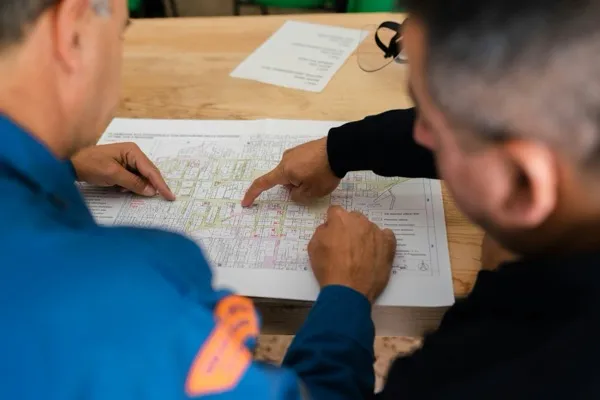

Think about the last time a senior PM left your firm. A principal-level project manager with ten or more years of jurisdictional history. She had the direct line that skipped the building department queue. She knew which reviewer at the planning commission ran on a 6-week cycle versus the one who moved in three. She had relationships that took a decade to earn.
When she left, that capital walked out with her. The next project in those jurisdictions reset to zero. No trust reservoir. No institutional memory. Just your firm's name on a cover sheet that nobody recognizes.
Architecture infrastructure isn't just your BIM licenses and project management software. Every time a senior PM walks out the door, your agency relationships walk out with them— and in our experience, most firms have no system to stop it. With architecture and engineering firms losing roughly 30% of staff annually6, this isn't a rare event. It's a recurring systems failure— and your AI implementation approach will keep running into this wall until you treat the underlying problem like the infrastructure gap it is.
The problem isn't that your PM left. The problem is that your firm was one person deep in critical agency relationships.
The Front End Is Where Projects Stall
"The bottleneck has never been the construction itself," Propmodo3 wrote plainly. "It has been the front end of the process— the code research, the application preparation, the compliance checking, and the reviewer bandwidth." Commercial building permits typically take 6–12 months1, and the clock starts before a single shovel hits the ground.
Projects don't move through one reviewer. They move through multiple independent agencies— each with its own timeline, queue, and review cycle4. One agency's clearance is often required before the next begins review. Miss a documentation standard in any single lane and the whole train stops.
Here's what that landscape looks like on a typical commercial project:
- Planning & Zoning
- Building Department
- Fire Marshal
- Public Works
- Health & Environmental Review
- Utilities
- Transportation
- Historical Preservation (on applicable projects)
Post-pandemic, the problem compounded. City permitting staff turnover was "very high" according to Bohler Engineering2— new junior reviewers lacked guidance from experienced colleagues and added "unnecessary complexity and slowdowns" to an already fragmented process. Your trusted reviewer from two years ago may not be there anymore.
The hidden costs of system gaps go well beyond any single project delay. McKinsey estimates $100–140 billion in unrealized returns are stuck in US permitting pipelines nationally5— a number that confirms the bottleneck is systemic, not firm-specific. But the root cause is something your firm can change: most architecture firms treat agency relationships as incidental to project management rather than essential to it.
What "Architecture Infrastructure" Means
Architecture infrastructure includes the documented systems, relationships, and institutional knowledge that allow a firm to execute projects predictably across jurisdictions and over time. Agency relationships are part of that infrastructure— but most firms haven't built them that way.
Your BIM licenses have a maintenance contract. Your PM software has an admin. When someone with admin rights leaves, you don't lose the tool. Agency relationship knowledge is also capital— but most firms let it live in individual PMs' heads and phones until it doesn't.
BIM Heroes7 put it plainly:
"Shared folders store files. An architecture firm knowledge system builds predictable, scalable, high-quality delivery."
Extend that logic to relationships, not just documents. Firms working repeatedly in the same jurisdictions accumulate review advantage over time. The reviewer already knows your documentation style. The pre-application contact trusts your process. You're not starting from zero on every project— that's a compounding asset, not a soft benefit.
The contrast is stark. A transactional approach means your firm introduces itself to the building department fresh with each project. No institutional memory on either side. No shortcut earned. And here's the part that stings: most principals only discover this gap when the delay is already baked into a live project schedule.
The Hidden Cost — When Staff Turnover Hits Both Sides
Architecture firm staff turnover runs around 30% annually6. Every PM who leaves takes their agency contacts with them. Meanwhile, city permitting departments saw some of their highest turnover rates during and after the pandemic— and the institutional knowledge your relationships depended on walked out their door too.
Bohler Engineering2 put it directly:
"There is so much institutional knowledge built up on the city side, and there's been very high city turnover during and post-pandemic as the nature of permitting review work changed so drastically."
That's the real problem in one sentence. Your PM leaves. The reviewer she worked with leaves. Neither side has a record of the other.
But the best firms don't absorb that disruption— they have a playbook for it. When a reviewer changes2:
- Contact the new reviewer proactively. Don't wait for the delay to surface in a missed response or a returned submittal.
- Provide full project history. Prior decisions, prior approvals, next steps, outstanding issues. Context doesn't transfer automatically; you have to deliver it.
- Maintain contact with former reviewers. They often land in other jurisdictions and become a network asset when you need a call that gets returned.
These responses require documented project history to exist in the first place. You can't do a proper handoff if the history lives in the departing PM's head. The solution isn't stronger personal relationships— it's a system that makes your relationships survive any individual departure.
What a Firm-Level Agency Relationship System Looks Like
An agency relationship system has three core components: a contact map, jurisdiction-specific notes, and transition protocols. Together, they make agency knowledge firm-owned rather than PM-owned.
1. The Contact Map
For every jurisdiction your firm works in regularly: primary reviewer name and contact, secondary contacts, review cycle notes, documentation preferences, and a log of prior projects. This doesn't require enterprise software. A shared CRM, an AEC-specific project management platform, or a well-maintained shared document all work. The format matters far less than the habit— it needs to be accessible to every PM, updatable, and structured to survive any individual's departure.
2. Jurisdiction-Specific Notes
How does this jurisdiction handle FAR calculations? What documentation standard triggers resubmittals? Which setback interpretation has your firm navigated before? The logic BIM Heroes applies to documents applies equally to relationships7: institutional knowledge needs a system to survive, not just a folder to live in. Jurisdiction notes encode what normally walks out the door with one PM— code interpretation preferences, documentation standards, the FAR variance your firm navigated successfully in this jurisdiction two years ago.
3. Transition Protocols
When a PM changes— or when a reviewer changes— there's a defined handoff process. Bohler Engineering2 describes this as providing full project history, prior decisions, and next steps to the incoming reviewer proactively. Doing this right can mean the difference between months of delay and a smooth handoff.
| Component | What It Captures | Who Maintains It | Lives Where |
|---|---|---|---|
| Contact Map | Reviewer names, contacts, review cycle notes, project history | Every PM (firm-shared) | Shared CRM or AEC PM platform |
| Jurisdiction Notes | Code interpretation, documentation standards, friction points | Every PM (firm-shared) | Same as contact map |
| Transition Protocols | Handoff process, prior decisions, next steps | PM lead, updated at each change | Linked to contact map per jurisdiction |
Pre-Application Meetings as a Firm Habit
According to Allen-Norris1, firms using pre-application meeting strategy see 30–40% faster approval times. That number only materializes if it's a consistent firm protocol— not a preference that belongs to one PM. Build systems your team will adopt and the pre-application meeting becomes standard procedure, not heroics.
Permit Expediters: Serve the Project, Not the Firm
Permit expediters serve as the point of contact for every reviewing department— building, zoning, fire, and engineering10. According to Allen-Norris1, expediters save an average of 3–4 months on complex commercial projects. They're valuable. But they don't build your firm's internal knowledge base. Use expediters for project complexity; build the system for firm durability.
Where AI Fits in the Permitting Workflow
AI is changing permitting— primarily on the city side, where AI-powered review tools are shortening queues that used to take weeks of staff review. For architecture firms, the near-term opportunity is using AI to reduce resubmittals through better pre-submission compliance checking.
Before AI-assisted review, Honolulu's commercial permits had a median wait time of 393 days8— a baseline that has since begun to change as AI review tools rolled out. Bakersfield, California, now processes permits in 10–15 minutes using an AI review system— down from staff hours and days previously, with over 500 permits handled in the first six months3. Austin adopted Archistar for residential review in 2024, with commercial expansion planned as of that reporting8. The queue problem is being worked from the city side.
On the architecture firm's side, tools like CivCheck (now Clariti) and PermitFlow help prepare compliant submissions before they reach the building department— reducing the resubmittals that add weeks to timelines. The AEC Associates9 reported that firms using AI compliance tracking achieved 40% faster approvals in their client work.
But here's the honest take. AI can help you prepare a better permit package— fewer errors before submission, fewer resubmittals that add weeks. It cannot replace the reviewer who already trusts your firm's documentation— that still has to be built. AI accelerates the workflow; it doesn't replace the relationship capital that makes the workflow predictable. No matter the question, people are the answer.
The questions AEC principals ask most often about permitting timelines and AI tools:
FAQ
How long does a commercial building permit take?
Commercial permits typically take 6–12 months or longer1. Timeline depends on jurisdiction, project complexity, and the number of reviewing agencies involved— planning, building, fire, utilities, and environmental boards can each add weeks independently.
What is the biggest cause of permitting delays for architecture firms?
Documentation errors, multi-agency review fragmentation, and staff turnover inside reviewing agencies are the primary causes43. The front end— code research, application preparation, compliance checking— is where most delay accumulates, not the construction phase itself.
What is a permit expediter and when should architecture firms use one?
A permit expediter acts as liaison between your firm and every reviewing department— building, zoning, fire, and engineering— managing submissions and resolving issues across jurisdictions10. On complex commercial projects, expediters save an average of 3–4 months1. They serve the project; an internal agency knowledge system serves the firm.
How are AI tools changing the building permit process?
AI is primarily accelerating city-side review: Bakersfield processes permits in 10–15 minutes with AI, down from hours3. On the architecture firm's side, AI compliance-checking tools reduce resubmittals before submission— industry reports suggest firms using these tools see up to 40% faster approvals9.
Relationships Compound, But Only If You Build the System
Every project you complete in a jurisdiction is a deposit. Every pre-application meeting is a deposit. Every reviewer transition handled professionally is a deposit. But only if you have a system that holds what you've built.
Relationship capital compounds— but only when the system captures it. The firms building their agency relationship infrastructure today are creating an advantage that competitors can't replicate by next quarter. It's built in projects, not purchased. A useful starting point: map where the gaps are. Contact maps that don't exist yet. Jurisdiction notes that live in one PM's email. Pre-application habits that belong to one person and not the firm.
If mapping your firm's systems and AI readiness feels like a significant lift, Dan Cumberland Labs works with professional services firms on exactly this kind of structured assessment. And if you're thinking about AI governance strategy as part of that picture, firms that build these systems proactively create optionality— they're not reacting to the next staff change; they're ready for it.
References
- Allen-Norris Construction, "Why Permitting Takes So Long (And How to Speed It Up): Insider Tips for Frustrated Builders" (2024) — https://www.allen-norris.com/why-permitting-takes-so-long-and-how-to-speed-it-up-insider-tips-for-frustrated-builders
- Bohler Engineering, "Predictable Progress: How to Navigate Review Agency Turnover and Maintain Momentum" (2024) — https://bohlerengineering.com/blog/insight/predictable-progress-how-to-navigate-review-agency-turnover-and-maintain-momentum/
- Propmodo, "AI Might Finally Be Starting to Fix the Broken Permitting Process" (2025) — https://propmodo.com/ai-might-finally-be-starting-to-fix-the-broken-permitting-process/
- Peacock Architects, "Common Reasons Projects Get Delayed in Permitting" (2024) — https://www.peacockarchitect.com/perspective/common-reasons-projects-get-delayed-in-permitting
- McKinsey & Company, "Unlocking US Federal Permitting: A Sustainable Growth Imperative" (2023) — https://www.mckinsey.com/industries/public-sector/our-insights/unlocking-us-federal-permitting-a-sustainable-growth-imperative
- We Collabify, "Understanding the Impact of Architecture Firm Turnover" (2024) — https://wecollabify.com/how-to-overcome-high-turnover-rates-in-architecture-and-engineering-firms/
- BIM Heroes, "Why Your Architecture Firm Needs a Knowledge System, Not Just Shared Folders" (2025) — https://bimheroes.com/the-architecture-firm-knowledge-system/
- Construction Owners Association of America, "AI Helps Los Angeles, Austin, and Honolulu Slash Permit Wait Times" (2025) — https://www.constructionowners.com/news/cities-turn-to-ai-to-speed-up-permit-reviews
- The AEC Associates, "Permitting Challenges Solved With Digital Documentation" (2024) — https://theaecassociates.com/blog/permitting-challenges/
- Scout Services, "Fast Permitting Solutions Benefits for Architects: Streamlining Design-to-Construction Workflows" (2024) — https://www.scoutservices.com/resources/blog/fast-permitting-solutions-benefits-for-architects-streamlining-design-to-construction-workflows/