Eighty-eight percent of organizations report using AI in 2025, yet only 7% have successfully scaled it across their business. The difference isn't which tools they chose — it's whether they strategized before they implemented.
This gap should concern every founder watching competitors experiment with AI. Gartner research reveals that despite an average spend of $1.9 million on GenAI initiatives in 2024, less than 30% of AI leaders report their CEOs are happy with AI investment return. Only 1 in 5 AI initiatives achieve ROI. Only 1 in 50 deliver true transformation.
Here's what matters: AI mastery is fundamentally about thinking skills and strategy, not just tactics. The founders who win aren't those with the biggest technology budgets — they're the ones who answer "why" and "what" before "how."
| The AI Adoption Paradox | Statistic | Source |
|---|---|---|
| Organizations using AI | 88% | McKinsey 2025 |
| Organizations that scaled AI | 7% | McKinsey 2025 |
| Initiatives achieving ROI | 1 in 5 | Gartner |
| Initiatives achieving transformation | 1 in 50 | Gartner |
| Average GenAI spend (2024) | $1.9M | Gartner |
| CEO satisfaction with AI returns | <30% | Gartner |
So if it's not the technology causing failure, what is it?
The Real Barriers (And They're Not What You Think)
Sixty-three percent of AI implementation challenges stem from human factors — not technical limitations. Data governance, organizational resistance, and inadequate change management determine success far more than model selection or API capabilities.
People are the answer, not AI. This isn't a feel-good platitude; it's what the data shows. According to HBR research, 62% of leaders cite data governance challenges — particularly around access and storage — as their top obstacles to AI adoption. Not lack of access to advanced models. Not insufficient computing power. Data.
| Human vs. Technical Barriers | Percentage | Source |
|---|---|---|
| Human/organizational factors | 63% | Deloitte |
| Data governance challenges | 62% | HBR |
| Technical limitations | ~37% | Derived |
McKinsey's 2025 research confirms that high performers are three times more likely than their peers to have senior leaders demonstrating ownership of and commitment to their AI initiatives. Three times. Leadership commitment isn't a nice-to-have — it's the multiplier.
The top organizational barriers to AI success:
- Data quality and governance — 62% cite this as their primary obstacle
- Change management gaps — organizations investing in change management are 1.6x more likely to exceed expectations
- Leadership misalignment — creates conflicting priorities and stalled initiatives
- Skills gaps — teams need training before tools
- Operating model mismatch — "Too many firms discover that their bold AI pilots collapse when their operating models can't support them," HBR notes
For founder-led businesses in professional services, this hits differently. According to RSM, "Without proper data structure, even the most advanced AI models simply won't work." Client confidentiality, regulatory requirements, and fragmented information systems create unique governance challenges.
Understanding where things actually go wrong points us toward what an effective strategy must address.
What AI Strategy Actually Means
An AI strategy is a documented plan outlining how your organization will implement, manage, and use AI to achieve specific business objectives aligned with overall business goals. It answers "why" and "what" before "how."
This distinction matters. Google Cloud puts it clearly: strategy focuses on the "what" and "why" of AI; implementation focuses on the "how." Most businesses skip straight to "how" and wonder why their pilots never scale.
AI Strategy defined: A documented plan that identifies high-value use cases, establishes governance frameworks, aligns organizational capabilities, and creates measurable pathways to business value — before selecting any specific tools or vendors.
Why documentation matters: according to Microsoft's Cloud Adoption Framework, "a documented AI strategy produces consistent, faster, auditable outcomes compared to ad-hoc experimentation." A successful AI program anchors each use case to a quantified business objective, not a model-first experiment.
| Strategy vs. Implementation | Strategy | Implementation |
|---|---|---|
| Focus | Why and what | How |
| Output | Documented plan | Working systems |
| Timeline | Precedes execution | Follows strategy |
| Key question | What value will AI create? | Which tools should we use? |
Two frameworks dominate the conversation, and they're complementary rather than competing:
Gartner's Seven Workstreams: Gartner's AI roadmap divides strategy into seven interdependent workstreams — strategy, value, organization, people and culture, governance, engineering, and data. Each requires attention; neglecting any one creates bottlenecks.
Microsoft's Four-Part Model: Microsoft's approach emphasizes use case identification, technology strategy, data strategy, and responsible AI governance working in concert. Simpler, but still complete.
And here's something McKinsey's research emphasizes: your strategy must be dynamic. AI strategy must evolve alongside your business priorities, market trends, and the risk landscape. Static plans become obsolete.
Knowing what strategy means is one thing. Building one is another. Here's where to start.
Your First 90 Days: A Practical Roadmap
The most effective AI strategies start with one high-value use case tied to a measurable business outcome, not a complete enterprise rollout. The Crawl-Walk-Run methodology recommended by the U.S. Small Business Administration gives founder-led businesses a path to value without seven-figure budgets.
According to the SBA, "AI adoption does not have to be expensive — businesses can start with low-cost AI tools such as Google AutoML, Microsoft Power BI, or open-source AI platforms to prove value before committing significant resources."
| Phase | Timeline | Focus | Success Metric |
|---|---|---|---|
| Crawl | Weeks 1-4 | Single use case, pilot scope | Working proof of concept |
| Walk | Weeks 5-8 | Expand to 2-3 use cases, establish governance | Measurable productivity gains |
| Run | Weeks 9-12+ | Scale successful patterns, build team capabilities | Business KPI impact |
Here's a practical 90-day roadmap:
Step 1 (Weeks 1-2): Identify 2-3 High-Value Use Cases
Tie every use case to a business outcome, not a technology experiment. Ask: What's our most time-consuming, repeatable task? Where do we lose deals or clients? What does our team dread doing?
Microsoft's framework helps categorize your options: SaaS solutions (Copilots, ready-made tools), PaaS (development platforms for custom work), or IaaS (managed infrastructure for advanced builds). Most founder-led firms start with SaaS.
Step 2 (Weeks 3-4): Assess Organizational Readiness
Audit your data quality. Inventory your team's skills. Check leadership alignment. These three factors predict success better than any technology decision.
If your data is scattered, siloed, or inconsistent, fix that first. HBR's research is clear: "While 74% of companies grapple with achieving meaningful value from their AI investments, the 26% that succeed share a common trait — they prioritized their knowledge foundation before their algorithms."
Step 3 (Weeks 5-8): Establish Governance Foundations
The NIST AI Risk Management Framework provides voluntary guidelines for incorporating trustworthiness into AI design — a governance foundation suitable for founder-led businesses without requiring enterprise resources. Start with four core components: definitions, inventory, policies, and a governance framework.
Don't skip this. Governance isn't bureaucracy; it's how you maintain quality and avoid costly mistakes as you scale.
Step 4 (Weeks 9-10): Launch One Pilot Project
Clear success metrics, defined upfront. Limited scope, high visibility. This pilot should answer a specific question: Does this approach work for our business? When connecting strategy to execution, your AI implementation decisions become much clearer.
Step 5 (Weeks 11-12): Measure and Iterate
Track both hard metrics (time saved, error reduction, cost impact) and soft metrics (team adoption, satisfaction, learning curve). Document learnings. What surprised you? What would you do differently?
The best founders I've worked with don't treat strategy as a separate phase from doing. Daniel Hatke, who runs two e-commerce businesses, faced $25,000+ quotes from AI consultants. Instead of paying for someone else's roadmap, he built his own AI optimization strategy — saving that consulting cost while creating something his team could actually execute. Strategy doesn't have to mean hiring expensive experts; it means thinking clearly before acting.
Professional services firms face unique considerations in this process.
For Professional Services Firms Specifically
Professional services firms face distinct AI challenges: RSM research shows junior consultants see 43% productivity gains from AI while seasoned professionals experience only 17% gains in complex, knowledge-intensive tasks — a pattern that requires rethinking both implementation strategy and business model impact.
Professional Services Productivity Data - Junior consultants: 43% productivity gains - Senior professionals: 17% productivity gains - Task completion improvement: 25% - Source: RSM
This isn't a bug; it's a feature of how AI handles different work types. Routine tasks (research, first drafts, data gathering) benefit enormously. Complex judgment calls? Less so. Your strategy must account for this reality.
Key considerations for professional services:
- Data quality is your #1 barrier — RSM identifies data quality as the biggest obstacle to AI adoption in professional services, where client confidentiality and fragmented systems create unique challenges
- Business model impact matters — How does faster work affect your billing model? Fixed-fee arrangements may benefit; hourly billing faces disruption
- Knowledge work transforms differently — You're redesigning workflows for human-AI collaboration, not automating away expertise
- Workflow redesign has the biggest effect — McKinsey's research confirms that redesigning workflows has the largest impact on EBIT from generative AI
For consulting, legal, accounting, and advisory firms, strategy isn't optional — it's how you capture value without commoditizing your expertise. Understanding AI fundamentals helps your team make better decisions about where AI adds value versus where human judgment remains essential.
Regardless of industry, measuring success requires a specific approach.
Measuring Success: The ROI Framework
AI ROI requires measuring both hard metrics — cost savings, revenue impact, efficiency gains — and soft metrics like decision speed, employee satisfaction, and competitive positioning. McKinsey research shows 39% of organizations report EBIT (earnings before interest and taxes) impact from AI, though in most cases it represents less than 5% of total EBIT in early stages.
Set realistic expectations. Early returns are modest. Transformation takes time.
| Hard vs. Soft Metrics | Hard Metrics | Soft Metrics |
|---|---|---|
| Examples | Hours saved, error reduction, revenue increase | Decision speed, team satisfaction, adoption rate |
| Timeline | 6-18 months for clear ROI | Often visible within weeks |
| Measurement | Quantitative, financial | Qualitative, experiential |
| Importance | Justifies investment | Predicts long-term success |
Establish baseline KPIs before AI implementation begins. Without knowing where you started, you can't demonstrate where you've arrived. This advice comes from both Propeller and Gartner's best practices.
| Timeframe | What to Measure |
|---|---|
| Months 1-3 | Pilot performance, adoption rate, immediate time savings |
| Months 4-6 | Productivity metrics, error rates, team feedback |
| Months 7-12 | Cost impact, revenue influence, competitive positioning |
| Year 2+ | Business transformation, strategic advantage, new capabilities |
Gartner recommends a portfolio approach to ROI — measuring across your AI initiatives rather than expecting every project to show immediate returns. Some experiments fail. That's the point. You're learning what works for your specific business.
For a deeper look at tracking what matters, our guide on measuring AI success covers KPI frameworks in detail.
Beyond frameworks and metrics, leadership commitment determines whether any of this works.
The Leadership Imperative
High performers are three times more likely than their peers to have senior leaders who demonstrate clear ownership of and commitment to AI initiatives. Leadership commitment isn't about enthusiasm — it's about clear direction, resource allocation, and removing organizational barriers.
What leadership commitment actually looks like:
- Setting clear direction — Articulating why AI matters and what success looks like
- Allocating resources — Budget, time, and attention, not just cheerleading
- Removing barriers — Actively addressing data silos, policy blockers, and cultural resistance
- Modeling behavior — Using AI tools themselves, not just delegating
- Enabling workflow redesign — Sponsoring the changes that capture value
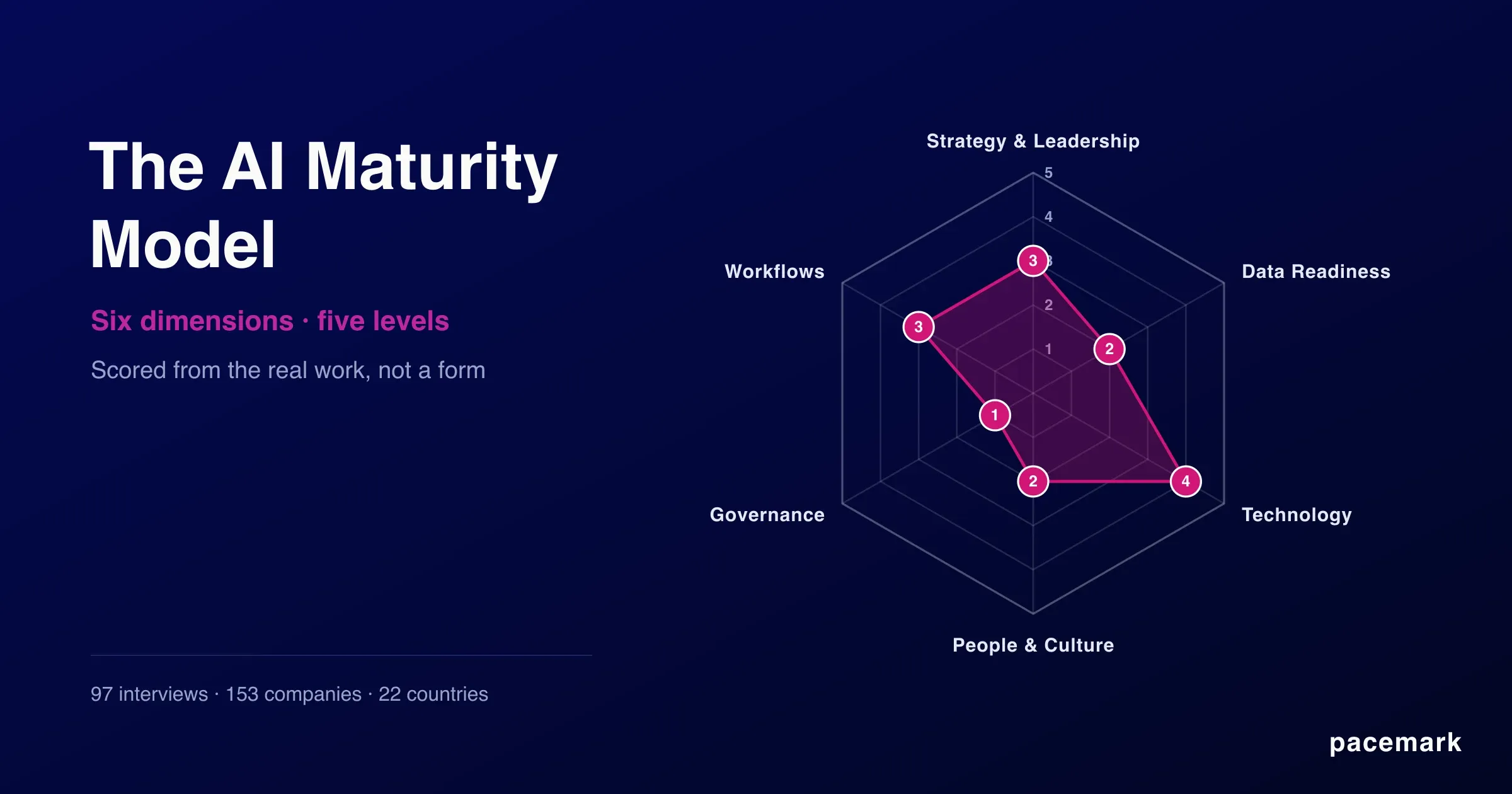
McKinsey identifies six management dimensions essential to capturing value from AI: strategy, talent, operating model, technology, data, and adoption/scaling. Leadership touches all six.
Should you hire a Chief AI Officer? Maybe not. HBR research suggests this often fails when the role is too broad. A cross-functional workgroup with a clear AI business sponsor is typically more effective for founder-led businesses. The goal is distributed capability, not centralized expertise.
Even with strong leadership, certain mistakes appear again and again.
Common Mistakes to Avoid
The most common AI strategy mistake is treating AI as an isolated technology project rather than an organizational transformation that touches strategy, talent, operations, and culture. This single misstep explains why high adoption rates produce low scaling rates.
According to Google Cloud, starting with a solution instead of a problem — the backward approach — explains why 70-95% of AI implementations fail. Most failures are caused by strategic errors, not technical limitations.
The top 5 mistakes to avoid:
- Treating AI as an isolated project — AI transforms workflows, not just tasks. Isolated pilots never scale because they don't change how the organization works.
- Solution-first thinking — "We need to use AI" is not a strategy. Entrepreneur Magazine notes that board meetings often feature "we need an AI strategy" without defining what problem AI should solve.
- Skipping strategy for speed — Jumping to implementation feels productive but creates tech debt and abandoned pilots. The 88% adoption rate proves this isn't working.
- Insufficient change management — Remember: 63% of barriers are human. Tools don't fail; organizations fail to adapt to tools.
- Poor data preparation — Starting with AI before fixing data quality is like building on sand. It collapses under pressure.
Avoiding these mistakes requires a systematic approach — which is exactly what strategy provides.
Frequently Asked Questions
Do I need a Chief AI Officer?
Not necessarily. While many companies appoint a single CAO, HBR research shows this often fails when the role is too broad. A cross-functional workgroup with a clear AI business sponsor is typically more effective for founder-led businesses.
How much does AI strategy development cost?
You don't need expensive consultants to start. Internal workshops using frameworks like Gartner's seven workstreams or Microsoft's four-part model can be conducted with your existing leadership team. The SBA recommends small businesses use low-cost tools to prove concepts before committing significant resources.
How long does AI strategy take to show results?
Timeline varies by scope: pilot projects typically show results in 3-6 months, while organizational scaling takes 1-2 years. McKinsey research shows 39% of companies see EBIT impact, though it's typically less than 5% of total EBIT in early stages. Expect soft metrics (decision speed, satisfaction) before hard financial ROI.
Will AI replace our employees?
Research on professional services shows AI improves productivity (43% for junior consultants, 17% for senior) rather than replacing roles. The critical strategic question is whether you'll redesign workflows for human-AI collaboration or attempt AI as a standalone replacement — strategy determines the outcome.
What if we've already started implementing AI without strategy?
It's not too late to strategize. Many organizations begin with experimentation and then formalize strategy once they understand opportunities and barriers. Document what's working, identify gaps, and create a roadmap forward — a documented strategy will still produce more consistent outcomes than continued ad-hoc experimentation.
Strategy First, Tools Second
AI strategy isn't a luxury for enterprises with dedicated innovation teams — it's the prerequisite that determines whether founder-led businesses capture value or join the 93% who adopt AI but fail to scale it. Strategy first, tools second.
Return to that opening statistic: 88% adoption, 7% scaled. The gap isn't explained by technology access. Everyone has access to the same tools. The gap is explained by strategic clarity — knowing why you're implementing AI, what outcomes you're targeting, and how you'll measure success.
People plus process plus governance beats technology selection every time. This is what the research shows. This is what distinguishes high performers.
And here's the encouraging part: it's not too late. The territory is still wide open for founders willing to explore it strategically. Even if you've already started experimenting with AI, you can still step back and strategize. Document your learnings. Align your leadership. Fix your data. Create a roadmap.
For founders navigating their first AI strategy, working with someone who understands founder-led business context — the resource constraints, the competing priorities, the need for practical over theoretical — often accelerates the process. AI strategy consulting isn't about handing you a generic framework; it's about building something that fits your specific situation.
The founders who win in the next few years won't be those with the biggest AI budgets. They'll be the ones who thought clearly before acting. Strategy determines outcomes. Everything else is implementation detail.